

Charitable Remainder Trusts
Turn your appreciated assets into cash
A Charitable Remainder Trust (CRT) is a trust that can be funded with cash, real estate or stock to produce income for the lifetimes of you and a loved one. The funds are invested to grow with inflation and can be paid monthly, quarterly or annually, according to your preferences. At the end of the trust, Children’s Medical Center Foundation receives the remainder of the funds to make life better for children.
How it works
The asset is transferred into an irrevocable Charitable Remainder Trust.
The funds are invested, and Children's Medical Center Foundation receives income from the trust as a beneficiary for a pre-determined number of years.
We pay you and/or a loved one payments for life.
The remaining funds are distributed to Children's Health after your lifetime(s).
Benefits
Receive income for life for yourself and/or a loved one
Receive a charitable income tax deduction and avoid capital gains tax
If funding with real estate, step down from the role of landlord and leverage an alternative to a 1031 exchange
Make life better for children
Example: CRT funded with real estate
Carl and Louise, ages 80 and 83, own an apartment building that produces an annual income of $81,000. They no longer wish to act as landlords but do not want to give up their consistent income stream. With an outright sale, they would incur significant capital gains taxes on the appreciation of the property. Instead, they choose to transfer the property into a Charitable Remainder Trust, sell the property and invest the proceeds in the trust. They receive a payments for their lifetimes that are higher than their current rental income. At the end of the term of the trust, the remainder goes directly to making life better for children at Children’s Health.
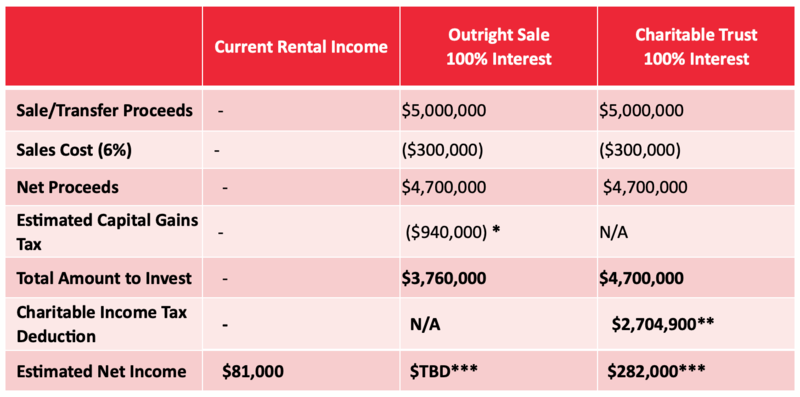
*Estimated blended Federal Long-Term Capital Gains Tax Rate of 20%, assumes an estimated cost basis of $0.
**Based on the donor ages of 83/80. This deduction can be used to offset other tax liability and can be carried forward for an additional five years.
***The estimated net income in the outright sale column depends on how the client decides to invest the net proceeds from the sale of the property. The net income from the Charitable Trust example reflects a 6% return based on its annual value.
These calculations are estimates and used for illustration purposes only and should not be considered legal, accounting, or other professional advice. Your actual benefits may vary depending on several factors, including the timing of your gift.
Our team is here to help
Our team of experts is here to help review the types of properties that may be well-suited for a CRT and work with our investment partners to turn your proceeds into a diversified portfolio.
If you have questions or would like to review a custom proposal, please reach out to  GiftPlanning@childrens.com or 214-456-8360.
Important Considerations
Before pursuing this giving method, donors should be aware of the following:
CRTs are irrevocable: Once assets are transferred into a Charitable Remainder Trust, the gift is irrevocable. Donors cannot reclaim the asset. This decision should be made carefully and with professional guidance.
Income payments are taxable: Payments received from a CRT are subject to a four-tier system of income taxation (ordinary income, capital gains, other income, then return of principal). The tax character of distributions depends on what the trust earned. Consult your tax advisor for more information.
Professional trustees are recommended: While donors can serve as their own trustee in some cases, many donors work with professional trustees or financial institutions to ensure proper management and compliance.
Well-suited for real estate and appreciated assets: CRTs are particularly advantageous for donors with low-basis appreciated property such as real estate, as the trust can sell the asset and reinvest proceeds without triggering immediate capital gains.
This information is not intended as tax, legal, or financial advice. Consult your personal financial advisor for information specific to your situation.
Key Rules and Guidelines
The following IRS rules, limits, and requirements apply to this giving method:
Minimum 5% annual payout: IRS regulations require that a CRT pay out at least 5% of the trust's net fair market value annually to the income beneficiaries.
Maximum 50% annual payout: The payout rate cannot exceed 50% of the initial net fair market value of trust assets. The IRS imposes this limit to ensure a meaningful remainder passes to charity.
Minimum 10% remainder interest: At least 10% of the initial net fair market value of the trust must be expected to pass to charity (calculated using IRS actuarial tables). If the 10% test is not met, the trust does not qualify.
Term limits: CRTs can be structured for the lifetimes of the income beneficiaries or for a fixed term not exceeding 20 years, or a combination.
IRS Form 5227: CRTs must file IRS Form 5227 (Split-Interest Trust Information Return) annually to report trust income, expenses, distributions, and compliance with tax rules. A copy of the trust document must also be maintained.
Rules and limits referenced above reflect current law. Tax law is subject to change. Please consult a qualified tax or legal professional for advice specific to your situation.
Interested in learning more?
Reach out to our Legacy & Gift Planning team today to learn about ways to make a tax-smart gift.
Let us know
If you have been so generous as to already include Children’s Medical Center Foundation in your plans, please complete our recognition form to join our Bradford Society.

