
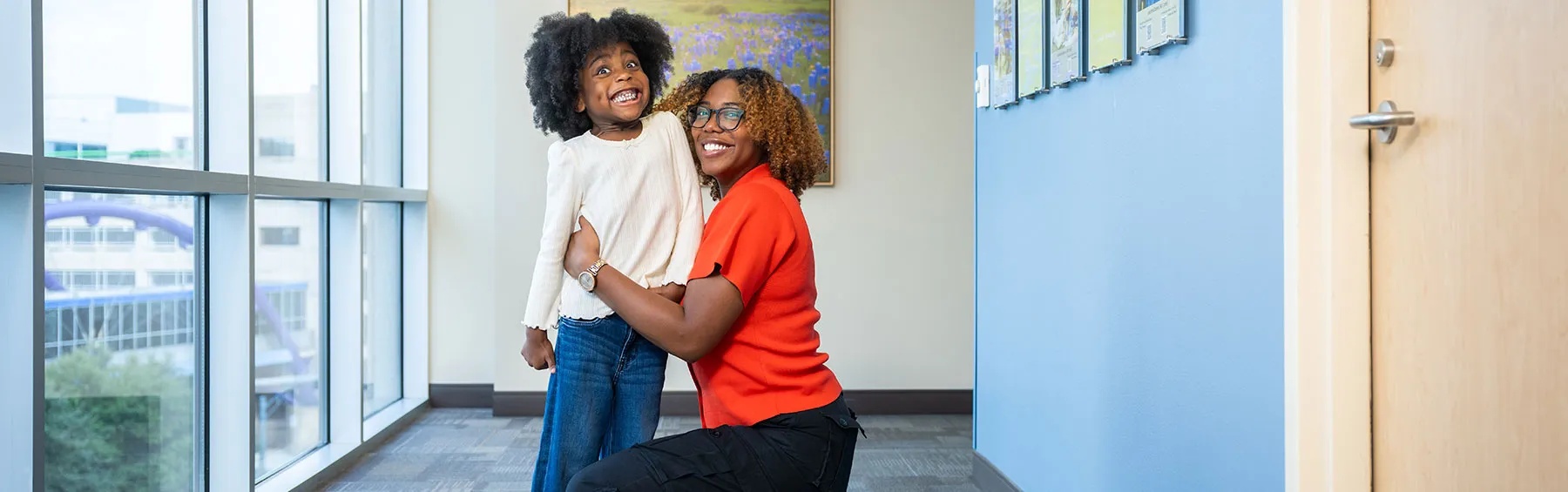
Meet Noa, who’s breathing on her own and finding her voice
From the moment she was born, Noa needed medical equipment to help her breathe. But thanks to expert care from Children’s Health, she can now breathe on her own and do things her family couldn’t have imagined before.
As a mom who moved her daughter across three states to get the care she needs, Sheronda knows all too well why a hospital just for kids — with specialized programs and leading-edge expertise — is critical.
“My daughter has needed specialized care from her first breath,” Sheronda said. “Many places would not have been able to take her on and give her this quality of care.”
Their journey with Children's Health started at the height of the COVID-19 pandemic, when Sheronda strapped baby Noa in her car seat, packed up their life and started driving.
“All roads lead to Dallas,” Sheronda said.
Small but mighty
Sheronda had no issues with her pregnancy until the 25th week, when her physician sent her to the emergency room because her vital signs were significantly elevated. That’s where she was diagnosed with a rare but life-threatening pregnancy complication called HELLP syndrome. She needed to deliver her baby right away.
Noa came out at a pound and four ounces. That doctor saved both our lives and told me, ‘Your daughter is small, but she is mighty.’
— Sheronda, Noa's mom
The following months were a blur of procedures and treatments to get Noa eating and breathing well. Like many premature babies, Noa’s lungs weren’t fully developed, and she needed a tube to help her breathe.
At 4 months old, Noa still wasn’t breathing well. Her physicians learned she had a severe form of a condition called subglottal stenosis, which meant her airway was too narrow to work normally. Her team performed a tracheostomy, creating an opening in her windpipe to help her breathe.
A specialized program for kids with breathing problems
After six long months in a hospital in New York, Noa was finally well enough to leave, and Sheronda decided to return to her home state, Kansas, to be closer to her mom and sister.
Although they were finally with their support system, the closest pediatric hospital was an hour away. Driving that far with a medically fragile baby was nerve-wracking, and that hospital didn’t have a specialized program for kids like Noa.
That’s when Sheronda started exploring other options and learned about the Airway Management Program at Children’s Health. The program is home to a team of experts with special training and deep expertise in caring for kids with tracheostomies — including Stephen Chorney, M.D., pediatric otolaryngologist at Children’s Health and assistant professor at UT Southwestern Medical Center, with expertise in a procedure that could widen Noa’s airway and give her the potential to breathe on her own.
Dr. Chorney told me, ‘Mom, we got you. Your daughter will be fine. We’ll have her walking, running, singing and swimming. As a mom, that was the confidence, knowledge and bedside manner I needed.
— Sheronda, Noa's mom
Moving to Dallas for expert care
Noa and Sheronda relocated to Dallas, hopeful about the procedure’s benefits. Sheronda’s mom and sister also moved to Texas to offer their family their support.
With all of Noa’s medical issues and breathing complications, Sheronda was grateful not only for the medical expertise at Children’s Health, but for the ways their care team made being in the hospital a little easier.
“Everyone truly cared for Noa, and they made me feel okay about leaving her bedside if I had to do laundry or just get a little fresh air,” Sheronda said. “The music therapists also helped both of us calm down and even let Noa play the guitar.”
As the population and health care needs of North Texas experience enormous growth, Children’s Health is reimagining how to provide incredible care for the next generation of kids — and that dream is turning into reality with the construction of the new Dallas pediatric campus, a joint investment with UT Southwestern Medical Center.
The new campus will further our ability to pioneer innovative academic research and lifesaving technology and treatments with an exclusive focus on the unique needs of young patients like Noa, so more children can get back to being kids.
When the day came for surgery to widen Noa’s airway, the procedure went well, though Noa’s recovery took a little longer than planned. But her care team was ultimately able to get her off the trach — and wean her off medication that helped her breathe.
Just before starting pre-K, Noa left Children’s Health and went back home breathing on her own for the very first time.
Finding her voice
Month by month, Noa’s appointments at the hospital dropped off the calendar. She has fewer visits to pulmonology, now that she’s breathing on her own.
“When Dr. Chorney scheduled our next visit for a whole year out, I couldn't believe it,” Sheronda said.
These days, Sheronda and Noa are building their lives in Texas, thankful for the ever-expanding specialized care made possible by the generous support of donors. With Noa healthier than ever, Sheronda is back at work helping kids with autism full-time and pursuing a graduate degree in her field. Noa is busy being a typical 6-year-old, loving art, learning to read and exploring music.
For a while she wasn’t able to speak. And now she’s not only finding her voice, but she’s got this beautiful singing voice. She’s doing so many things I never knew were possible and that’s magical to see.
— Sheronda, Noa's mom
Meet more Children's Health patients
Read more patient stories like Noa's and meet our Patient Ambassadors to learn how Children's Health makes life better for children.
How you can help
Help kids like Noa by exploring our ways to give or by giving today!
Kids count on us. We count on you.
Give to support innovative research, lifesaving treatments and compassionate care.
Did you enjoy this story?
If you would like to receive monthly eNewsletter updates sharing new stories like this one, please complete the form below. We won't share your information, and you can unsubscribe any time.

