
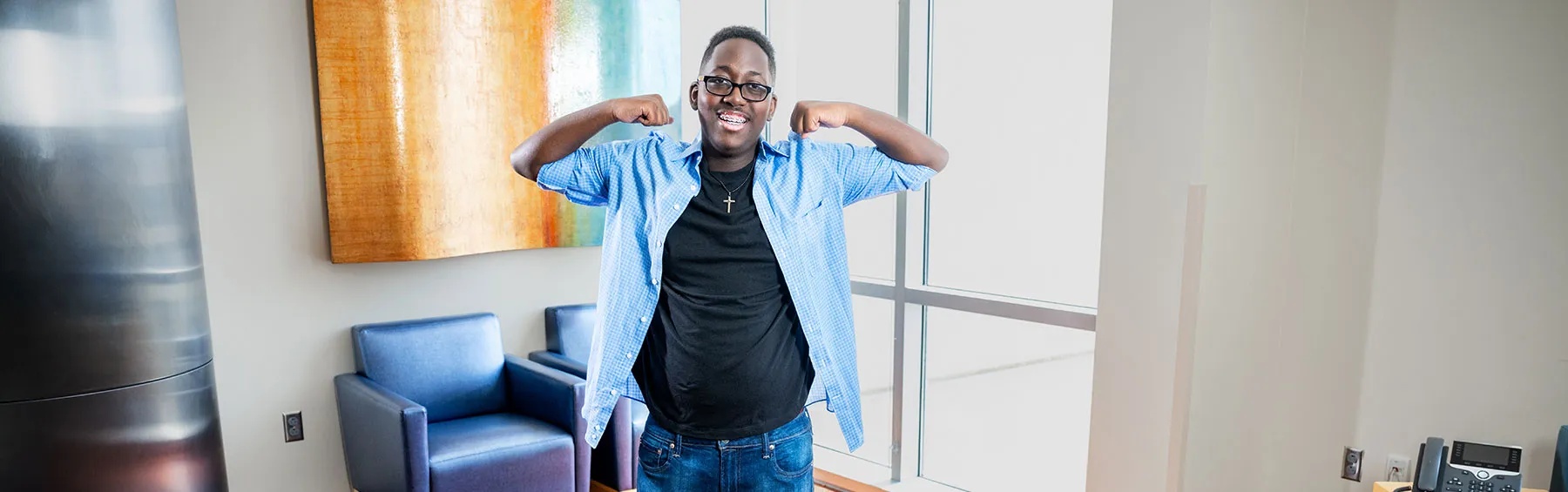
Meet Micah, who has the biggest heart
After finding out he needed a heart transplant, 13-year-old Micah set out to make sure teens facing transplant have all the support they need.
One afternoon, then-13-year-old Micah came home from school, and his mom asked if he wanted to toss a ball around. Usually bursting with energy, Micah surprised her when he declined.
He told Brittany, his mom, he was having chest pain.
Brittany’s ears perked up. Given her medical history, she knew symptoms like these deserve quick attention.
Shortly after giving birth to Micah, she was diagnosed with heart failure. She endured two heart surgeries and ultimately received a heart transplant. And, just as she was adjusting to her new heart, another diagnosis emerged — stage 4 lymphoma.
Through each diagnosis and surgery, Micah watched his mother defy the odds.
But neither of them imagined that one day Micah might need a new heart, too.
A heart working overtime
The next morning, Brittany took Micah to the pediatrician. The doctor found nothing alarming but referred him to the Heart Center at Children’s Health℠ as a precaution.
Specialized care team members at the Heart Center perform more than 500 cardiac surgeries each year, offering everything from minimally invasive approaches to complex heart surgeries.
I never felt as a parent like anything they did was a cookie cutter thing that they do for every kid. It felt like everything was tailored to my kid. That helps us as parents to relax because I know I can trust my child to these people.
— Brittany, Micah's mom
At the hospital, Micah’s EKG reading — which provides information about the heart rhythm, rate and structure — came back highly abnormal. Yousef Arar, M.D., Pediatric Cardiologist at Children's Health and Assistant Professor at UT Southwestern, decided to do an echocardiogram (echo), also known as a cardiac ultrasound, to examine the heart.
After reviewing the images, Dr. Arar pulled Brittany aside.
"This is the worst case of hypertrophic cardiomyopathy I've ever seen,” he said. “I don’t know how Micah’s organs are getting blood, let alone how he’s running a mile every day."
Micah's enlarged heart was working overtime. His ejection fraction — the measurement of a heart’s strength — was only 7%. The average ejection fraction is typically 50% or more. He also had ventricular tachycardia, a fast, abnormal heart rhythm from the bottom chambers of his heart.
Brittany felt every maternal fear surge through her body, but their care team made sure the family felt supported throughout their care journey.
Physicians immediately admitted Micah to the acute care cardiology unit and scheduled him for a procedure to implant a device that would help control his heart rhythm.
Jordan Ezekian, M.D., Pediatric Electrophysiologist and Assistant Professor at UT Southwestern, consulted on Micah’s care and determined that his heart problems, like his mom’s, were likely due to genetics. So, she ordered tests that confirmed that they both had a genetic form of cardiomyopathy.
"I looked at his mom’s chart and his chart, and it seemed clear that there was something going on genetically,” Dr. Ezekian said. “Meanwhile, our transplant team determined he was going to need a heart transplant, just like his mom.”
Once again, Brittany found herself facing the unimaginable. But this time, she’d be the one watching Micah defy the odds.
"Just like that, again, my life literally flipped on a dime," she said.
Incredible moments to be a kid again
Micah’s procedure to control his heart rhythm went well, with the Children’s Health extracorporeal membrane oxygenation, or ECMO, team on standby to provide support, which, thankfully, Micah did not need.
And while Micah waited on his new heart, his hospital stay included some incredible moments to be a kid again thanks to generous donors, such as playing video games with other patients in the playrooms and cuddling with the Pet Therapy dogs.
Children’s Health is able to heal kids so well because it has amazing donors who make amazing contributions that allow kids to keep being kids. Donations help the hospital keep children in their childhood, in their imagination — regardless of what’s going on.
— Brittany, Micah's mom
And now these donations are powering the future of pediatric health care in North Texas.
Children’s Health is building a new Dallas pediatric campus, a joint investment with UT Southwestern Medical Center, to expand access to pediatric health care. The new campus will strengthen our collective ability to care for all children, especially for medically complex cases like Micah.
“Children’s Health is on the forefront of making sure that every possible advantage is used and making sure that these children heal and heal well,” Brittany said. “I could not be more excited that Children’s Health is investing in the future of his health this way.”
The need for peer support
The timeline for a new heart is unpredictable. And while the family waited, Brittany went to a caregiver support group.
When she returned, Micah said, “Mom, what time is my support group? I’m the one that is going to have the transplant.”
Having been through a heart transplant herself, Brittany assured Micah she understood what he’d soon go through and would be glad to talk to him about it. She also had friends from the transplant community who could provide support.
Children’s Health also offers patient support groups for hospitalized transplant patients, coordinated as often as infection control measures allow. The "Transplant Heroes" patient group, a 4-week program held multiple times a year, is designed for children awaiting or recovering from transplants. This group provides a space for fun and games while promoting understanding of organ transplants, immunosuppression medication, peer communication about medical conditions and coping skills.
But Micah wasn’t satisfied. He worried about kids who didn’t have a mom with similar experiences, like Brittany, or resources like those at Children’s Health — who didn’t have anyone to guide them through the fears and uncertainties of transplant life.
Despite experiencing the impossible, inspiration overtook him. He wanted to develop a way for teens like him to connect from anywhere in the world.
Stepping up to support other teens
When Micah was younger, Brittany taught him about responsibility through the story of “Anybody and Nobody” — reminding him that if something needs to be done, anyone can step up to do it.
She never expected Micah to apply that lesson to do something much bigger than washing the dishes or picking up his LEGOs.
When Micah said, “I guess we’ll have to start our own online support group for teens,” Brittany felt overwhelmed.
But deep down, she wasn’t too surprised. Micah had seen his mom continually bounce back and pursue her dreams during and after her hospitalization.
She had built a life centered on resilience and purpose, so she wasn’t surprised her son shared her values and strength.
After some brainstorming and planning, Micah and Brittany launched Transplant Teenz, an online support community for teens undergoing or recovering from transplants.
In this virtual community, teens find connections and fun through themed squads like the “Binge Brigade,” who watch Netflix together, or the "Foodie Fighters," who share a love of food and cooking. During meetings, teens work on developing self-compassion or adaptability and discuss the realities of transplant life, like managing multiple medications.
“Teenagers have poorer post-transplant outcomes than younger kids. And that’s partly because teens aren’t great at paying attention to all sorts of things — including taking medicines. So, the idea of having teens support each other is a fantastic one,” said Ryan Davies, M.D., Pediatric Cardiothoracic Surgeon at Children’s Health and Professor at UT Southwestern, who ultimately led the heart transplant team that performed Micah’s transplant.
A successful heart transplant
Ten months after Micah got on the transplant list, Brittany’s phone rang — physicians had found a donor heart match for him.
Brittany remembers thinking, “Not only is my kid going to live, he’s going to thrive.”
In October 2024, Micah received his new heart at Children’s Health under the expert care of Dr. Davies, who, along with his transplant team, Brittany called her “dream team.”
“Micah and Brittany were terrific to work with. They were both so knowledgeable, but also trusting of the process,” Dr. Davies said. “They definitely did their part to make sure Micah was in the best health possible going into transplant and recovering from it.”
Micah left the hospital in just two weeks, eager to see friends who couldn’t visit him at the ICU. He knew he could trust his new heart when he felt ready to serve a tennis ball to his mom again.
More than a year after his transplant, Micah is helping train high school football and soccer players — and is considering studying sports medicine when he grows up.
He knows how hard it can be to heal from something. He’s been through it, so he wants to help athletes. I’m really proud of him for finding the silver lining and using what he went through to empower others instead of as an excuse.
— Brittany, Micah's mom
Micah and his mom continue to build Transplant Teenz, bringing hope to other teens and their families.
“In my future, I hope to develop Transplant Teenz even more, so it goes global,” Micah said. “And also, hopefully, become a trainer for the NFL and maybe, just maybe, become a professional player. Sky is the limit.”
Micah and his mom are grateful for the expert care at Children’s Health that’s provided him a second chance at life and a chance to pursue his dream of attending college “somewhere sunny.”
Together, Brittany and Micah plan to make the most of having a second chance.
"What Micah and I have learned through our journeys is something Charles Darwin said: 'The most important factor in survival is neither intelligence nor strength, but adaptability,' said Brittany. "At Transplant Teenz, we work on honing that superpower of adaptability."
Meet more Children's Health patients
Read more patient stories like Micah's and meet our Patient Ambassadors to learn how Children's Health makes life better for children.
How you can help
Help kids like Micah by exploring our ways to give or by giving today!
Kids count on us. We count on you.
Give to support innovative research, lifesaving treatments and compassionate care.
Did you enjoy this story?
If you would like to receive monthly eNewsletter updates sharing new stories like this one, please complete the form below. We won't share your information, and you can unsubscribe any time.

