
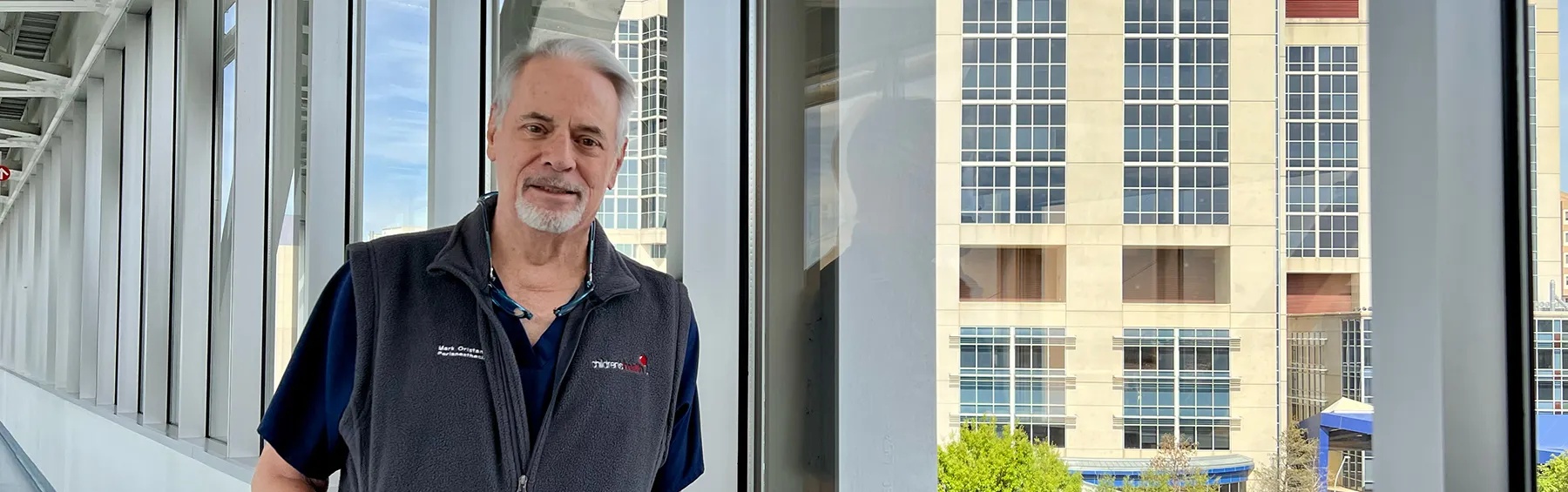
Mark
Volunteer Mark Oristano is the first to tell you he’s ‘not medical.’ But he’s essential.
Mark Oristano jokes that he could play a doctor on TV.
And after about three decades of volunteering in the Post-Anesthesia Care Unit at Children’s Health, he looks like the part.
He wears dark blue scrubs like the rest of the team (complete with an embroidered penguin holding a popsicle – the PACU’s mascot). And he moves easily around the floor, helping nurses when needed and greeting patients awake from surgery, typically with a hello and a joke.
If you haven’t caught on yet, Mark is a jokester.
But he’s serious about the work happening at Children’s Health to care for a growing number of kids.
For almost 30 years, he’s worked alongside the clinical team in the PACU – one of the busiest and most unpredictable areas of the hospital. He isn’t there to provide medical care, but he’s there to help the people who do.
The PACU is where children wake up from surgery, and no two moments look the same.
Some of them come out screaming and crying. Some of them get physical. ... You never really know what’s going to happen. But the nurses are phenomenal. I’ve never seen such a group of caring, loving people.
— Mark, Children's Health volunteer
In a room like that, the work is constant and the stakes are high. Mark has learned where he fits.
He keeps things moving. He fills in the gaps. He brings snacks for the nurses. And when the moment allows, he tries to make people laugh.
“I mean, that’s my goal in life,” he said.
Finding laughs in tough moments
A lot has changed since Mark first walked through the doors at Children’s Health, searching to make an impact outside his career as a sportscaster for the Dallas Cowboys.
Back then, the PACU was a single room with 13 beds, and the hospital was only a six-story building. And as Children’s Health grew to care for more kids, so did the unit.
During one transition into a new space, Mark noticed nurses tracking patient bays on a handwritten list, and he saw an opportunity to help.
He took the unit’s blueprints, scanned them and created a large visual map of the space to outline which patients were in what bays – a method the team still uses.
“That’s my little contribution,” he said.
But really, Mark’s impact is marked by the seemingly small moments with patients, families and team members, mostly through laughs.
He recalls families who visited multiple times and remembered his name because of a joke he made about a sports game. And he’s famous for telling kids to “milk it” as he wheels them out the door.
“Now, you know what you do when you get home?” he tells them. “You lie on the couch, and you say, ‘Can somebody hand me my phone? I can’t reach it.’”
He chuckles that the parents don’t always love that one, but the kids do.
Once, there was a little girl who recognized him at a Children’s Health event, calling him by name from a crowd. She told him how he made her laugh after her kidney transplant.
“That’s all the thanks I need,” he said.
For Mark, the decision to volunteer—and to stay—comes down to one reason: helping people.
“The reason we’re all here is to help each other,” he said. “There’s nobody more important to help than children.”
More than a volunteer
Over time, as Mark’s connection to Children’s Health deepened, volunteering became something more.
Several years ago, he established an endowment to support Child Life, where he initially started as a volunteer. Child Life specialists provide coping strategies to help make life easier for those experiencing the unthinkable and are offered at no cost to patient families.
“Because I’ve had a degree of financial success, I’m able to spread it around and do good for other people and help organizations like Children’s Health grow,” Mark said.
Mark also opted to leave the hospital system with an unrestricted gift in his will. This kind of general use support allows Children’s Health to fund areas of greatest need, while also helping the hospital to invest in new initiatives and enhance critical programs.
“We’re all here to help other people, and when you can get a group of people working together toward the same goal – to make life better for children – it's a great, great feeling,” he said.
Kids count on us. We count on you.
Give to support innovative research, lifesaving treatments and compassionate care.
Did you enjoy this story?
If you would like to receive monthly eNewsletter updates sharing new stories like this one, please complete the form below. We won't share your information, and you can unsubscribe any time.

