
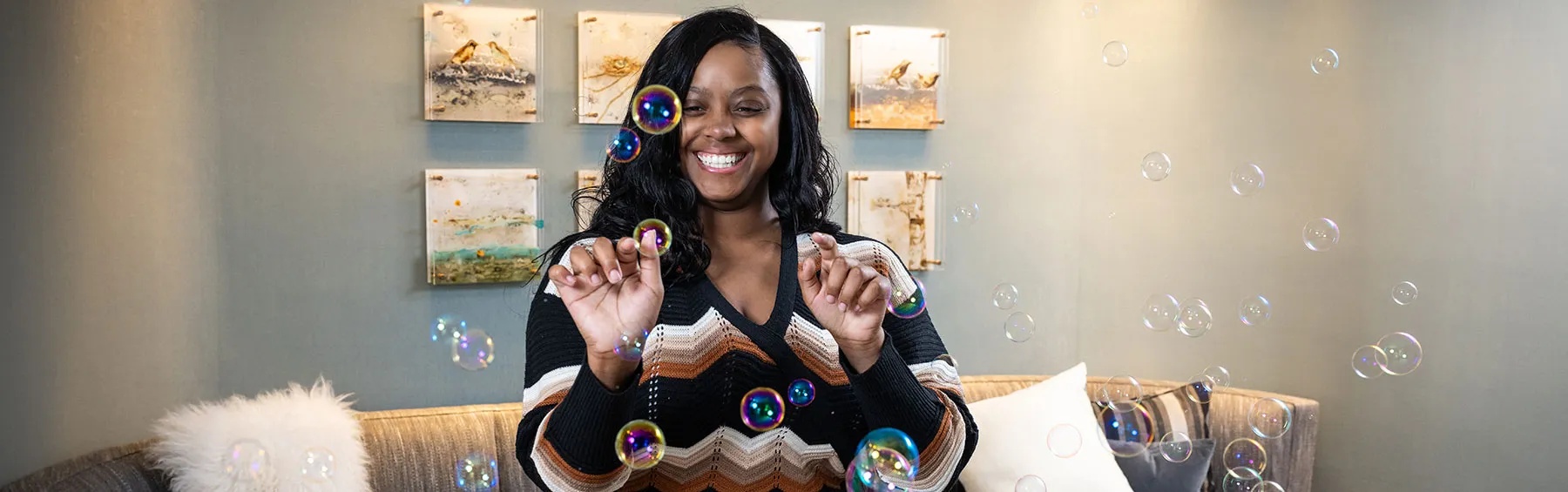
Meet KK, who held her faith closely and found hope
When KK learned of her leukemia diagnosis at Children’s Health, she felt overcome by a “wave of acceptance.” But with her family, care team and the health system’s leading-edge research on her side, she wasn’t ready to give up.
KK remembers the bruises that suddenly began appearing on her arms and legs, along with the intense headaches and discomfort caused by swollen gums that followed.
At first, she didn’t think twice about what was happening to her. Maybe she wasn’t getting enough sleep, she thought.
But big bruises continued appearing randomly and, at one point, her gums were so swollen, she struggled to even brush her teeth.
The symptoms “kept coming more frequently, and I started to lose my appetite more and more … which is very big for me because I’m an eater,” KK said.
Concerned, her mom, IlaSheika, took her daughter to a hospital in Tyler, their hometown.
There, physicians told her it was possible she had leukemia, the most common childhood cancer.
But KK didn’t feel scared or worried, really. The then-15-year-old remained almost stoic.
“It was just more like, ‘Wow, I might actually have leukemia,” she said. “I might actually have cancer.”
A ‘wave of acceptance’
Soon after KK and her mother received the potential diagnosis, they were sent to Children’s Health℠, home to one of the country’s largest pediatric leukemia programs.
After further tests, physicians diagnosed KK with acute myeloid leukemia (AML), which starts in myeloid cells in the bone marrow and quickly moves into the bloodstream. Myeloid cells are immature blood cells that later develop into oxygen-carrying red blood cells, infection-fighting white blood cells and blood-clotting platelets.
“I like to think of AML as being a little bit like the mafia,” said Richard Voit, M.D., Pediatric Hematologist/Oncologist at Children's Health and assistant professor at UT Southwestern Medical Center. “It's a gang that comes and invades a neighborhood, in this case the bone marrow, and wreaks havoc all over the body.”
The confirmation didn’t shock KK. Instead, she felt a “wave of acceptance.”
“If I end up passing away from cancer, it may be heartbreaking, but I’ll be reunited with Jesus,” she thought.
Still, KK didn’t abandon hope.
I was not ready to give up on life. I thought God still had a plan for me.
— KK, Children's Health patient
Finding hope through research
KK’s care team encouraged her as she went through two intensive months of chemotherapy and experienced significant complications, including a brain bleed as a side effect of her treatment that required her to undergo neurosurgery.
Her care team often joked around with KK to help take her mind off what she was going through and keep her in high spirits. She fondly recalls one physical therapist who would coax her out of bed during her toughest days by offering to play board or video games together.
“They were fun, even though I pretended they weren’t,” KK said with a mischievous smile.
But her leukemia barely responded to the treatment, even after receiving more chemotherapy.
That’s when her physicians recommended KK for a clinical trial that allowed her to access a new investigational medication developed by Dr. Voit’s colleagues specifically to get rid of AML cancer cells.
After two months of the new medication, along with more rounds of chemotherapy, KK was finally able to receive a successful bone marrow transplant, which helped stop the body from producing cancerous cells.
We couldn't find the leukemia anymore. As a physician, as a scientist, if that doesn't get me up out of bed in the morning, I don't know what will.
— Richard Voit, M.D., Pediatric Hematologist/Oncologist at Children's Health
Looking forward to the future
It’s now been months since KK’s bone marrow transplant — and there have been no signs of relapse.
“I’m feeling better. I’m feeling a lot stronger,” KK said. “I’m completely cancer free. I defeated cancer. My body is free from it.”
Incredible stories at Children’s Health, like KK’s own, are fueled by philanthropic funds, which are hard at work behind the scenes. Whether powering our people and programs, both inside the hospital and within our communities, or furthering our ability to make breakthroughs happen, these extraordinary stories would not be possible without generous support from our donors.
Committed to caring for the youngest members of our community, Children’s Health is investing in the way it makes life better for the kids — and teenagers — of North Texas for generations to come.
In partnership with UT Southwestern Medical Center, Children’s Health is building a new Dallas pediatric campus that will further our ability to pioneer innovative, academic research and lifesaving technology and treatments to care for the region’s, and the nation’s, most complex pediatric patients.
KK is sure seeing the community come together for children and teenagers like her, helping give “more kids a reason to keep fighting,” she said.
Now 17 years old, KK is looking forward to graduating high school and potentially joining the U.S. Navy.
“She wants to travel the world,” her mom, IlaSheika, said.
Although she still visits Children’s Health to check in with her care team every month, she’s happy to be in remission.
“I’m just chilling now,” she said with a smile. “I’m not taking any pills, I’m cancer free and life is good.”
Meet more Children's Health patients
Read more patient stories like KK's and meet our Patient Ambassadors to learn how Children's Health makes life better for children.
How you can help
Help kids like KK by exploring our ways to give or by giving today!
Kids count on us. We count on you.
Give to support innovative research, lifesaving treatments and compassionate care.
Did you enjoy this story?
If you would like to receive monthly eNewsletter updates sharing new stories like this one, please complete the form below. We won't share your information, and you can unsubscribe any time.

