
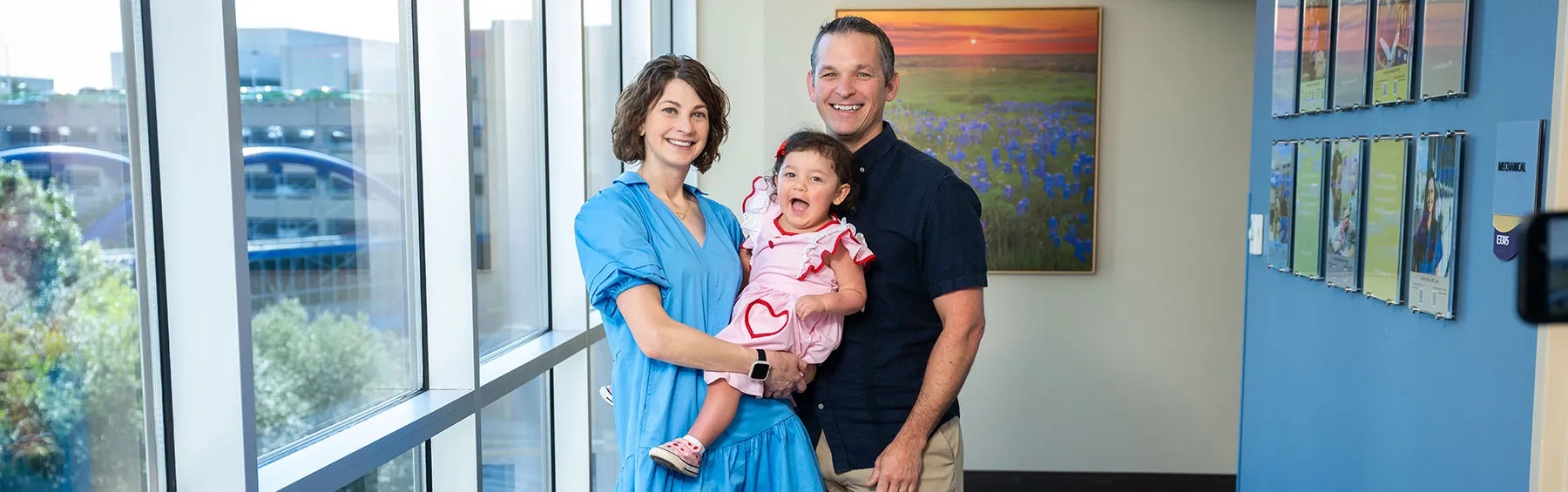
Meet Coco, who is catching up on milestones after two heart surgeries
Coco’s care team at Children’s Health℠ used leading-edge technology to plan her complex heart care months before she was born. Today, she’s getting into the routine of going to preschool.
Coco bravely marched into her classroom on the first day of preschool. Although her mom, Rachel, knew she’d be shy at first, it didn't take long for her to warm up to her teacher and classmates, who soon grew fond of her too.
Rachel cried just a little as she walked back to her car, reflecting on how proud she was of Coco, her little girl, and how far she’d come.
Before heading home, she sent a picture to the nurses who cared for her daughter during her long stays at Children’s Health — where their journey started after learning Coco’s heart was on the wrong side of her body.
A series of heart problems
Rachel, her husband Aaron and surrogate mom Claire — now Coco’s godmother — wondered what was happening when their pregnancy provider went quiet during the 14-week ultrasound. A day later, Rachel got a call that revealed why: something wasn’t quite right with her baby’s heart.
“I tried to stay calm, reminding myself that heart problems are common and affect 1 out of 100 babies,” said Rachel, who is a cardiology nurse who cares for adults with heart problems.
But the fear sank in as they learned the complexity of Coco’s heart anatomy: her heart was on the right side of her body, not the left (dextrocardia); the two main arteries going into the heart were reversed and in the wrong location (double outlet right ventricle and transposition of the great arteries); there was a hole between the heart chambers (atrioventricular canal defect); and she had an abnormal heart valve (pulmonary valve stenosis).
Their physicians referred the family to the Children’s Health Heart Center. Meeting Coco’s team and discussing her care plan weeks before her birth helped ease Rachel and Aaron’s fears a bit.
“We met case managers, intensive care doctors and heart care coordinators from Dallas and Plano,” Rachel said. “They had everything set up and ready for us and laid out plans for many different scenarios.”
Coco’s birth went smoothly, and Rachel and Aaron got a little bit of time with their new baby before she was transferred to the Heart Center at Children’s Health.
“It was very surreal seeing her looking up at us because she looked just perfect and alert,” Rachel said.
The Heart Center care team kept a close eye on her oxygen levels and took echocardiograms to fully understand the anatomy of her heart. After a few days, Coco was breathing well enough to go home. The goal was for her to remain stable enough at home before undergoing surgery in a few months — a much safer option than having surgery as a newborn. She exceeded everyone's expectations when she made it almost a year without needing any intervention.
“We were very blessed that first year,” Rachel said. “The second year was when things got hard.”
A detailed surgery plan
Historically, many children born with complex heart problems need either a heart transplant or a single ventricle repair, which repairs one side of the heart. But when only one side of the heart works properly, children often have poor circulation and other heart complications as they grow up.
That’s why Children’s Health launched a Pediatric Complex Biventricular Repair Program, led by Nicholas Andersen, M.D, Pediatric Cardiothoracic Surgeon at Children’s Health and Associate Professor at UT Southwestern Medical Center. The program offers biventricular repairs, fixing both sides of the heart, which typically leads to better long-term health.
Their family initially considered going to Boston for Coco’s care but decided to stay in Dallas when Children’s Health launched its Complex Biventricular Repair Program.
Coco’s heart anatomy was so complex that a traditional ultrasound didn’t provide enough detail for her care team to plan her surgery, so they used a state-of-the-art 3D cardiac MRI to take very clear images. Then, physicians printed a 3D model of her heart and made digital scans that they could study in virtual reality.
These tools helped the care team determine that mending both sides of Coco’s heart would be possible, and an important step before mapping out a two-stage surgery plan.
Whether powering our people and programs, both inside the hospital and within our communities, or furthering our ability to make breakthroughs happen, these extraordinary stories would not be possible without generous support from our donors.
As the health care needs of North Texas continue to grow, Children’s Health is spearheading an expansion that will strengthen our ability to care for the next generation of kids. Together with UT Southwestern Medical Center, Children’s Health is building a new Dallas pediatric campus that will further our ability to pioneer innovative, academic research and lifesaving technology and treatments to care for the region’s, and the nation’s, most complex pediatric patients, like Coco.
More than 100 days in the hospital
Coco’s first surgery went smoothly, but recovery was difficult.
“The first days after surgery were the worst,” Rachel said. “She was struggling and the pressure in her heart was very high. There were so many doctors all around her.”
Rachel and Aaron rarely left Coco’s bedside as she recovered over the course of more than 100 days at Children’s Health.
With the help of their care team, the family found small moments of joy — like decorating Coco’s room and celebrating her first birthday with a special sign and balloons from the Child Life team, who work alongside medical staff to ensure a positive experience for our patients and their families.
When Coco was discharged and able to go home, her family stayed in daily contact with her care team. But a few months later, when Coco was lethargic and not acting like herself, her parents rushed her back to Children’s Health where they learned she had an infection and was experiencing severe kidney problems.
They told us that bringing her in that day saved her life. From there, we stayed in the hospital until she could have the second part of her heart surgery.
— Rachel, Coco's mom
At 17 months old, Coco went into her second heart surgery. Her care team used the 3D model and virtual reality to practice the surgery before performing it.
Rachel still has a screenshot of the text Dr. Andersen sent her from the operating room after the surgery.
“The text read ‘Home run,’ with a picture of her oxygen levels at 100%,” Rachel said.
Leading-edge care, close to home
Today, Coco is catching up on her milestones, loving her two dogs and getting into the routine of going to preschool.
Looking back, Rachel appreciates so many things about Coco’s care: The chaplain who was always there to listen, the support groups for families in the Heart Center, the nurses, therapists and child life specialists who made being in the hospital a little easier.
“The staff in the Heart Center became like family to us. They all knew Coco and genuinely cared for her. Coco didn't like being in the hospital and made it well known; nights were especially difficult,” Rachel said. “In pediatrics, there is more room for humor and laughs. The staff went over and above to try to make her smile and get her, and us, through really hard times. As an adult nurse, we can learn from that. Sometimes laughter is the best medicine.”
More than anything, her family is grateful for the world-class care Coco received — and for the donors whose support helps allow Children’s Health to provide such specialized care and make life better for kids.
Having the advanced imaging to pick up on Coco’s complex heart issues before she was born and being able to make a care plan so early, that wouldn’t have been possible even just a few years ago. What the Heart Center team can do is mind-boggling, and that’s thanks in part to the people who make an investment in research and technology. Being able to get state-of-the-art care locally — rather than having to uproot our lives and be away from our support system — made all the difference.
— Rachel, Coco's mom
Meet more Children's Health patients
Read more patient stories like Coco’s and meet our Patient Ambassadors to learn how Children's Health makes life better for children.
How you can help
Help kids like Coco by exploring our ways to give or by giving today!
Kids count on us. We count on you.
Give to support innovative research, lifesaving treatments and compassionate care.
Did you enjoy this story?
If you would like to receive monthly eNewsletter updates sharing new stories like this one, please complete the form below. We won't share your information, and you can unsubscribe any time.

