
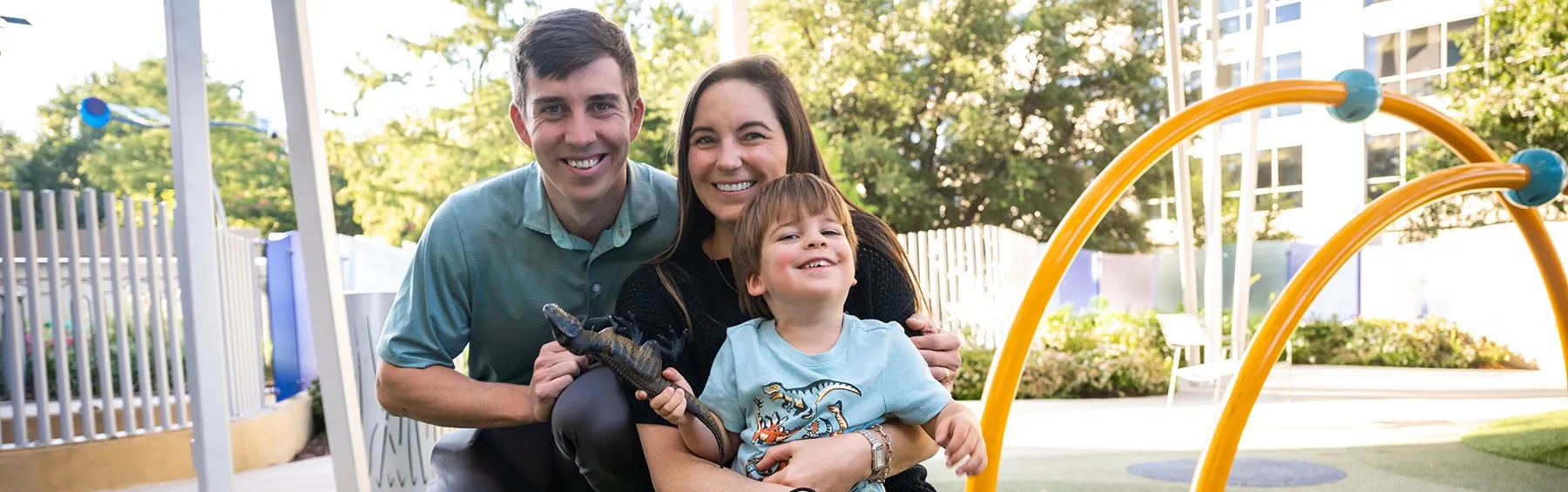
Meet Clark, who defied the odds and thrived
Clark’s fight for survival led to a milestone moment in NICU care — and his family’s lifelong gratitude.
When 3-year-old Clark smiles, his grin reveals more than just a sunny disposition.
“Clark’s two front teeth are chipped, from two different falls. He’s ‘all boy,’” his mom, Danielle, said. “He’s into animals and dinosaurs and just wants to be outside as much as possible — running, falling and bouncing off of things.”
But the Clark she describes today is different than the Clark that first entered the world.
A 50% chance of survival
When Danielle and David, Clark’s dad, were expecting their first child, they were thankful for a typical, healthy pregnancy. They went to birth classes together, read up on what to expect during pregnancy and couldn’t wait to start their journey of parenthood.
And then, in the middle of what started as a regular birth, “things hit the fan,” Danielle said.
Their physician saw signs of meconium (a baby's first poop). Newborns usually poop within a day or two after birth. But if they do so during birth, there's a chance of the baby breathing in that poop and amniotic fluid, which can cause serious complications.
“When he came out, he was awake but not making any noise,” Danielle said.
Physicians whisked baby Clark away and diagnosed him with severe meconium aspiration syndrome. Having meconium in his lungs had led to hypoxic-ischemic encephalopathy, a condition where a baby’s brain does not get enough oxygen and blood during birth.
Physicians were concerned about his brain function — and the function of his heart and lungs. They sedated Clark and put him on a cooling blanket in the hopes of protecting his brain, and he required the help of a ventilator to breathe.
At 5:45 a.m. the next day, Danielle and David hurried to the Neonatal Intensive Care Unit (NICU) for a serious conversation.
“Clark needs to be transported to Children’s Health for more specialized care — and there’s a 50% chance he will not survive the ambulance ride,” their physician said.
An incredible improvement in the NICU
David rode in the ambulance with Clark.
Stressful would be an understatement for that ride. Not often you’re relieved to see a room full of 20 medical professionals waiting for you in a hospital room, but that is what we walked into at Children's Health, and I felt nothing but thankful we were there.
— David, Clark's dad
In less than an hour, Clark was in the operating room, surrounded by the team who would connect him to a life support system called ECMO. This state-of-the-art machine can take over the function of a baby's heart and lungs, giving Clark's tiny lungs a chance to heal, and making sure he could get the oxygen he needed.
“From the moment Clark got to Children’s Health, his health and condition improved dramatically,” David said.
Clark stayed on life-saving ECMO for about a week, with two staff members monitoring him 24/7.
It took some time for Danielle and David to fully wrap their heads around how closely their care team monitored Clark and that he was one of the first babies to receive ECMO at Children’s Health. Prior to Clark, ECMO was only available for older kids in the Pediatric Intensive Care Unit (PICU).
While this lifesaving therapy has been available for kids for a while, its use in newborns is more recent. His family is deeply grateful that Clark had access to the latest in care, made possible in part by philanthropy.
Ensuring more families like Clark’s never have to leave North Texas to receive the health care their child needs, Children’s Health is investing in a new Dallas pediatric campus that will make room for emerging technology and foster deeper collaboration to make seemingly impossible discoveries that lead to possible new cures and treatments.
A joint investment with UT Southwestern Medical Center, the new campus will be transformative for pediatric health care and will ensure we are ready to meet the unique and wide-ranging needs of the region’s future pediatric population for decades to come.
An unforgettable team of experts
Having two full-time NICU nurses watching over Clark meant Danielle and David could be by his side at the hospital from his first feeding in the early morning to his last one in the early evening. And then, they could go home to sleep in their own bed, confident their son was in the best hands possible.
“The Children’s Health NICU nurses were incredibly helpful and reassuring,” David said. “They were always ready to give us an update as soon as we woke up.”
Danielle recalls some of the little things the nurses did to make Clark’s time in the hospital easier and to help her bond with a baby she couldn’t hold until he was 20 days old, like giving Clark pieces of fabric she’d keep under her clothes so he’d be familiar with her scent.
“We did that every day, and it helped us feel more bonded,” Danielle said.
Danielle also can’t say enough about the outstanding care they received from Dr. Sushmita Yallapragada, M.D., neonatologist and associate professor at UT Southwestern.
“I’m so obsessed with how wonderful Dr. Yallapragada is that if she asked me to do just about anything, I’d do it,’” Danielle said.
David also appreciated how welcoming the staff was of their large, extended family who wanted to be at the hospital as much as possible. He’ll never forget the day when Clark was finally strong enough for them to hold him — and how the staff helped Clark’s grandparents and aunts and uncles hold him too, even though he was still connected to several tubes.
Feeling forever grateful
After 40 days in the hospital, Clark’s little body was finally strong and healthy enough to go home.
For the next several months, they took him for various tests and follow-up appointments to make sure he was developing typically. They also participated in the Children's Health Thrive Program, for babies who have graduated from a stay at the NICU.
We were dismissed from Thrive after a year because Clark has had no long-term effects from the two conditions he was born with. Clark is now, miraculously, a typical, thriving 3-year-old.
— Danielle, Clark's mom
While Danielle and David are happy to leave their time in the hospital behind, they’re also determined not to forget the incredible care they received.
The family has started an annual tradition of gathering donations for Children’s Health to show their appreciation for the exceptional care they received. They’re also big supporters of the expansion of the hospital because they know that the more beds that are available, the more kids who can get the care they need.
“Everyone hopes they’ll never need the type of specialized care that Children’s Health can provide. But when a child does need it, you want the best care out there — for your child, grandchild or your nephew or niece,” David said. “I’m pretty sure Clark wouldn’t be here if it wasn’t for Children’s Health.”
Meet more Children's Health patients
Read more patient stories like Clark’s and meet our Patient Ambassadors to learn how Children's Health makes life better for children.
How you can help
Help kids like Clark by exploring our ways to give or by giving today!
Kids count on us. We count on you.
Give to support innovative research, lifesaving treatments and compassionate care.
Did you enjoy this story?
If you would like to receive monthly eNewsletter updates sharing new stories like this one, please complete the form below. We won't share your information, and you can unsubscribe any time.

